The MultiPlus 20k, and why Victron now counts in kilowatts.
Victron's biggest MultiPlus yet: 20 kW of continuous power from one 48-volt inverter-charger, a 250-amp charger, and three units for a three-phase system. It also carries a quiet change in the name — rated in kilowatts, not kVA — that makes every Victron spec sheet easier to read honestly. Here's what the unit does, and how to read the new numbers.
Designed in Lismore · installed by accredited locals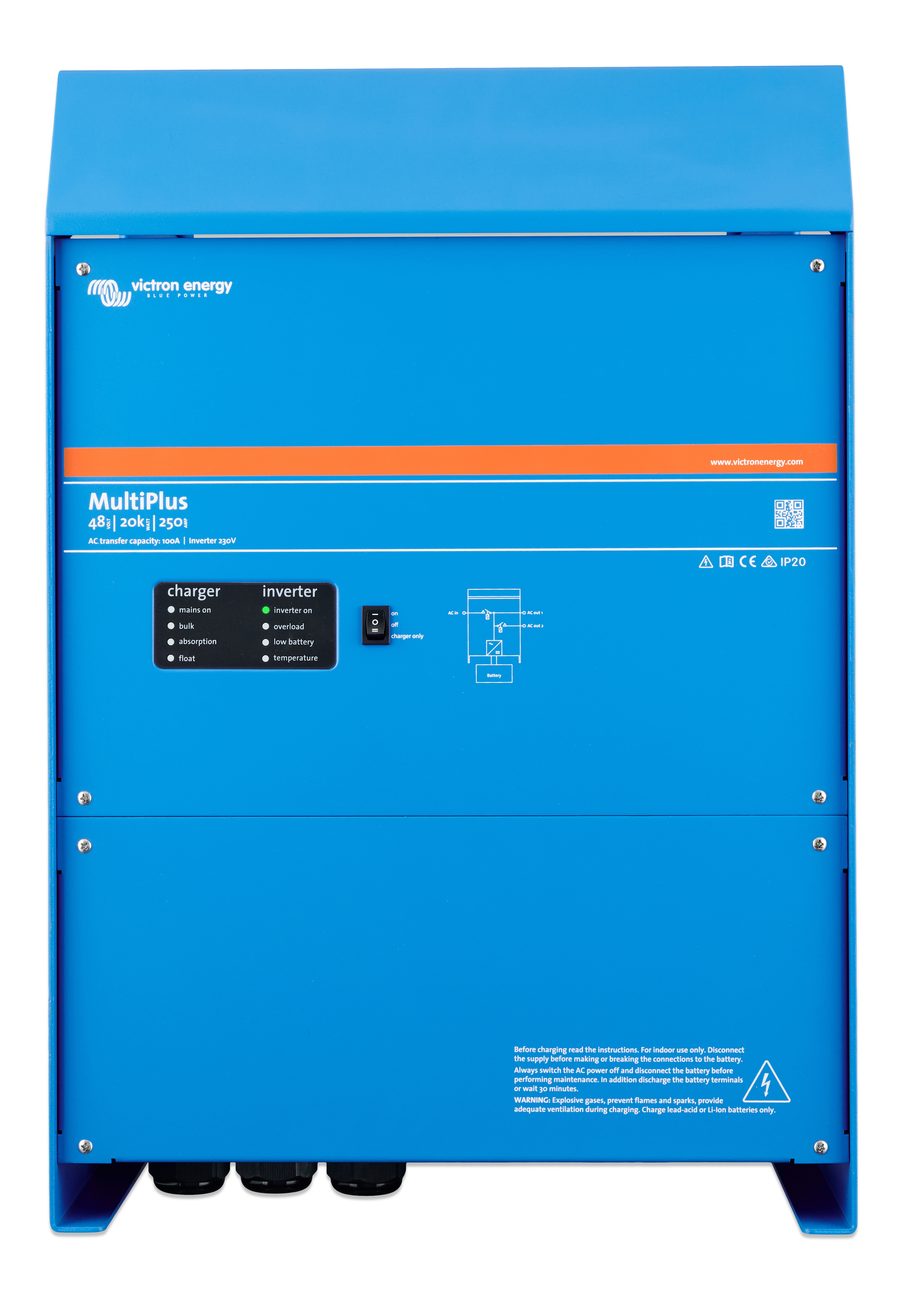
The MultiPlus 20k. Victron product photography.
What the MultiPlus 20k is
20 kW continuous — at 25 °C
Victron's datasheet gives 20 kW continuous at 25 °C, 18 kW at 40 °C and 14 kW at 65 °C, with a 25 kW peak for one minute. In an Australian plant room in February, the 40 °C figure is the one to design on. The one-minute peak is what starts pumps, compressors and workshop motors without drama.
250 A from a 48 V battery's point of view
A 250-amp charger (240 A at 40 °C) means a generator run puts serious energy back into the bank quickly — the difference between a two-hour top-up and an afternoon of diesel. PowerAssist lets a modest generator or grid connection carry a big load by adding battery power on top.
100 A AC input, under 20 ms transfer
Grid or generator arrives through a 100-amp input; when it drops, the changeover to battery takes less than 20 milliseconds, so computers, pumps and controllers never notice. Off-grid, that is the generator-to-battery handover happening cleanly, every time.
Three units, three phase
Three MultiPlus 20k units configure as a three-phase system, which puts large rural homes, farms and commercial sites on the same 48 V Victron platform as everything else we install — same GX monitoring, same VRM, same programmability.
kVA to kW: what changed, and why it matters
For decades inverters were rated in kVA — apparent power — because household loads distorted the current and an inverter had to handle more than the watts a load actually used. Victron's own explanation of the change: regulations now require most electronics to include power factor correction, “the gap between VA and watts has become much smaller, and newer Victron models such as the MultiPlus 20k and the MultiPlus-II 4k5 and 6k5 are now rated in watts, as this better represents the real usable power available to your loads.”
Watts are what you can use
Kilowatts are real power — the number your kettle, pump and air conditioner actually draw. kVA is apparent power, real power plus the extra the inverter carries when a load pulls current out of step with the voltage. The ratio between them is the power factor, and with modern appliances it sits close to one. So a unit rated in kilowatts is telling you the usable figure directly, and comparing it against an older model still rated in kVA flatters the older model unless you correct for it.
Practical rule when you read a spec sheet: compare kilowatts with kilowatts. A 5 kVA inverter and a 5 kW inverter are not the same size. When Victron writes 20k, 4k5 or 6k5, it means 20 kW, 4.5 kW and 6.5 kW of real, usable power. As Mike put it: “Instead of kVA, it's K — it's rated in kilowatts.”
How to read a Victron model number
| Part of the name | MultiPlus 48/20k/250-100 | What it tells you |
|---|---|---|
| First number | 48 | Battery voltage — a 48 V system (38–60 V operating range) |
| Second number | 20k | Output power — 20 kW continuous at 25 °C. Older models put kVA here; newer ones put kW. |
| Third number | 250 | Maximum battery charge current in amps |
| Last number | 100 | AC input and transfer switch rating in amps — the biggest grid or generator supply it passes through |
| Suffix | 230V | AC output voltage, the Australian standard |
Once you can read the name, every Victron spec sheet opens up. Efficiency on the 20k peaks at 96%, and idle draw is 65 W — 40 W in AES mode, 13 W in search mode — which is the number that decides how much of your winter sun goes to keeping the inverter awake.
Who a MultiPlus 20k is for
Large rural homes with electric cooking, air conditioning and a workshop running at once. Farms with pumps and cold rooms. Commercial sites that want to stay on the 48 V Victron platform rather than move to high voltage. Anywhere a single-phase property has outgrown the mid-sized inverters and the choice used to be a paralleled pair — one 20k does that job as one unit, and three of them make a three-phase system.
It is not the answer for a cabin or a tiny home; there, a smaller Victron or the rack-mounted RS19 fits better and idles cheaper. The load profile picks the inverter. Every design we do starts by counting the loads, and the inverter is chosen on the last page, not the first.
How to size your system correctly
Tell us about the property — the loads that run together, single or three phase, what storage exists already. If a MultiPlus 20k is the right inverter, the design says so with the working shown, sized on the 40 °C figure and with the battery bank and solar to feed it. If a smaller unit or a different platform fits better, the design says that.
Prefer to talk it through? Call or text 0483 927 257 — Lismore HQ, local voices.
MultiPlus 20k questions, answered
What is the difference between kVA and kW on an inverter?
Kilowatts are real, usable power; kVA is apparent power, which includes the extra current an inverter carries when loads pull current out of step with the voltage. The ratio is the power factor. Modern appliances with power factor correction sit close to one, which is why Victron now rates newer models in kilowatts.
Why did Victron change from kVA to kW?
In Victron's words, because regulations now require most electronics to include power factor correction, the gap between VA and watts has become much smaller, and rating in watts better represents the real usable power available to your loads. The MultiPlus 20k and the MultiPlus-II 4k5 and 6k5 are rated this way.
Is the MultiPlus 20k single phase or three phase?
A single unit is a 230 V single-phase inverter-charger. Victron's datasheet states that three units can be configured for three-phase output, which is how large homes, farms and commercial sites use it.
How much power does it really deliver in Australian heat?
Victron rates it at 20 kW continuous at 25 °C, 18 kW at 40 °C and 14 kW at 65 °C, with a 25 kW one-minute peak. A design for a hot plant room uses the 40 °C figure and ventilates properly; anything else is a brochure number.
Does the MultiPlus 20k work off-grid with a generator?
Yes. A 100 A AC input accepts grid or generator, the 250 A charger refills a 48 V bank quickly when the generator runs, PowerAssist adds battery power on top of a smaller generator for big loads, and transfer takes less than 20 milliseconds. Automatic generator start comes from the GX device.
Is a 20 kW inverter overkill for my house?
For most homes, yes; for a large rural home, farm or workshop with electric cooking, air conditioning and motors running together, no. The loads decide it. Ask for a design and the working will show whether a 20k, a smaller Victron or the rack-mounted RS19 is the honest fit.