Victron's rack-mounted inverters:
the RS19 and the HS19.
Released in 2026, these are Victron inverter-chargers built to slide into a standard 19-inch rack beside the batteries. The Multi RS19 Solar is the 48-volt, single-phase, 6 kVA unit with two solar trackers on board. The Multi HS19 Solar 15k is the high-voltage, three-phase, 15 kW unit with four. Same rack as the batteries, one cabinet, Victron monitoring on top. We're a Victron dealer of more than ten years, designing with both.
Designed in Lismore · installed by accredited localsThe inverter moves in with the batteries
Serious off-grid storage went rack-mounted years ago: 48-volt lithium modules stacked in a 19-inch cabinet, added one shelf at a time. The inverter, until now, lived on the wall beside it with a run of heavy DC cable in between. The RS19 and HS19 end that arrangement. The inverter-charger becomes another unit in the same rack — shorter DC runs, one enclosure to ventilate and secure, a plant room that reads as one system instead of a wall of boxes.
It also changes how a system grows. A rack has shelves. Storage, inverter and solar input all live in the same footprint, and expanding means filling the next slot rather than finding more wall.
Low voltage and high voltage, side by side
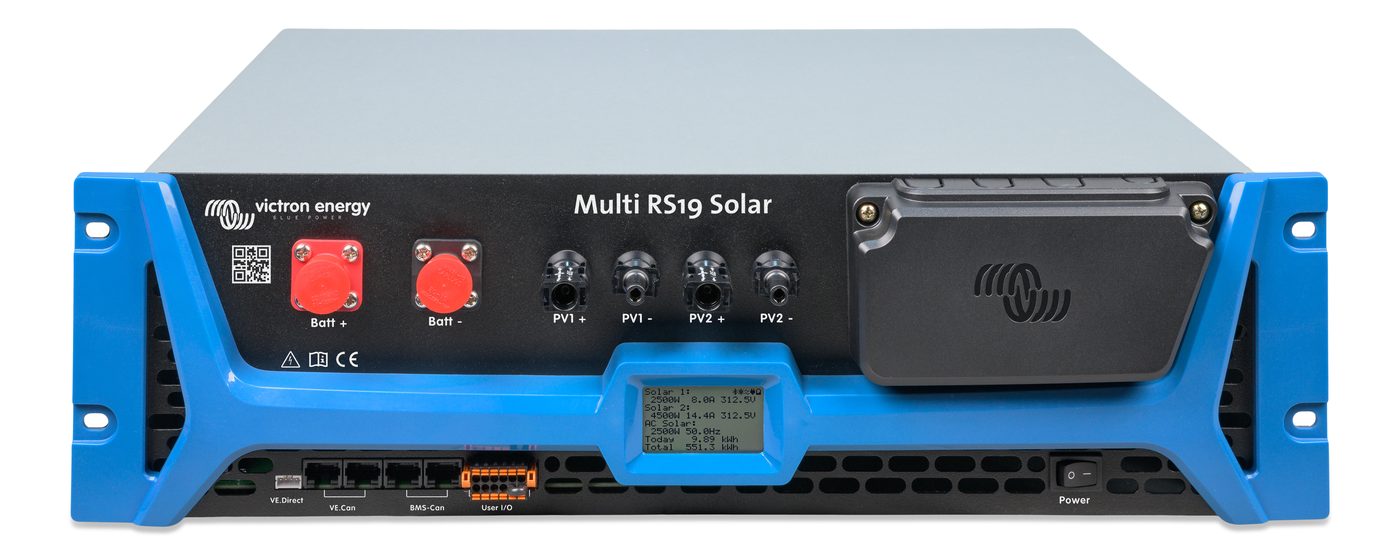 Multi RS19 Solar · low voltage
48 V · single phase · 6 kVA
A 19-inch version of the Multi RS Solar: 48-volt inverter-charger, 230 V single-phase output, two independent 3 kWp solar trackers accepting 65–450 V DC each for 6 kWp of PV in total. High-frequency design, integrated display, VictronConnect over Bluetooth, and a GX device connection for VRM — the new Nucleo GX is built for exactly this family. Runs off-grid, grid-connected with Dynamic ESS, or as backup for critical loads.
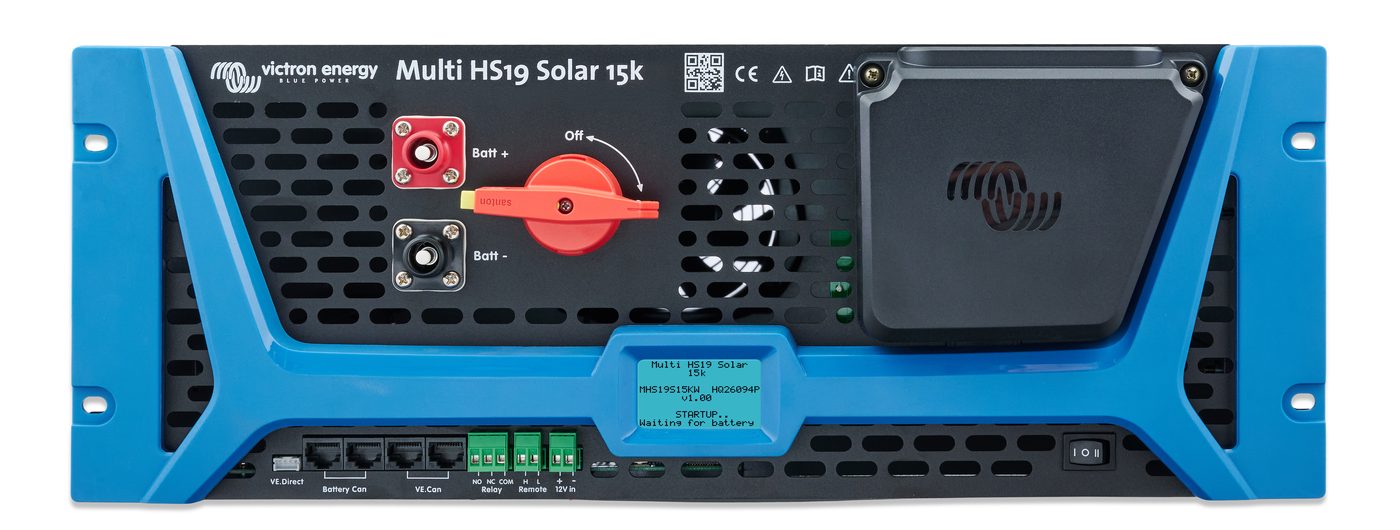 Multi HS19 Solar 15k · high voltage
650–1000 V · three phase · 15 kW
Victron's high-voltage inverter-charger in one 19-inch unit: full three-phase output, 15 kW continuous, four solar trackers taking up to 32 kW of PV at up to 600 V input, charging at up to 33 kW at 800 V. Works with managed CAN-bus batteries from 650 to 1000 V on Victron's compatibility list, weighs 26.5 kg, and reaches up to 98% inverter efficiency.
Why we're paying attention
“They're server-rack-mounted inverters, sitting in the same rack as the batteries. For off-grid, that's game-changing — and I'm pretty excited about it.”
— Mike Haydon, The Off Grid Shop
48 volts, or 650 to 1000 — which one belongs on your property
Forty-eight volts is the off-grid standard for good reason: the widest choice of batteries, decades of field experience, and gear any competent installer can service. Its cost is copper. Moving serious power at 48 V means high current, which means thick DC cable and careful design of every run. For homes, sheds and cabins on single phase, that trade is easily worth it, and the RS19 is built for exactly that world.
High-voltage DC turns the equation around. At 650 to 1000 V the same power flows at a fraction of the current, so cables shrink, losses fall, and three-phase output becomes practical from a single unit. The trade is choice: the HS19 works only with high-voltage batteries on Victron's compatibility list, and the system is engineered as a matched set rather than assembled from a parts bin. For large homes, farms and commercial sites with three-phase loads, that is the right trade. We check the compatibility list before a design is drawn, not after.
Comparing the Victron Multi RS19 and HS19 specifications
| What matters | Multi RS19 Solar | Multi HS19 Solar 15k |
|---|---|---|
| Battery voltage | 48 V (low voltage) | 650–1000 V (high voltage, managed CAN-bus batteries) |
| Output | 6 kVA, 230 V single phase | 15 kW continuous, full three phase |
| Solar input | Two trackers, 3 kWp each, 65–450 V DC — 6 kWp total | Four trackers, up to 32 kW, up to 600 V input |
| Form factor | 19-inch rack unit | 19-inch rack unit, 26.5 kg |
| Monitoring | Integrated display, VictronConnect, GX device to VRM | VictronConnect, dedicated VE.Can and battery CAN-bus ports, GX device to VRM |
| Battery choice | Wide — the 48 V world | Victron's HV compatibility list only |
| Typical fit | Homes, sheds, cabins and tiny homes on single phase | Large homes, farms, workshops and commercial sites on three phase |
| Warranty | Victron's standard five-year warranty, as stated by Victron for both units | |
Neither column is the upgrade of the other. They answer different properties. The loads, the phase supply and the battery you already own — or want — pick the unit.
What to know before you fall for the rack
They're new. Both units were released in 2026, and new Victron hardware matures through firmware for a while after launch. That is normal for Victron, and it's how a system keeps gaining capability — read our Victron page for why we see that as a strength. It also means early systems get designed with a little margin and a dealer who watches the release notes.
The RS19 is a 6 kVA unit. That carries a lot of homes and most sheds and cabins; it does not carry every property from one box. Loads get counted before anyone picks the inverter, same as every design we do.
The HS19 is a matched system. High voltage means the battery, inverter and solar are engineered together, and only batteries on Victron's compatibility list apply. If you already own 48 V storage, the HS19 is not the path — the RS19, or the wider 48 V Victron range, is.
A rack is a piece of equipment too. Ventilation, clearance and a dry, secure plant room are part of the design, not an afterthought.
Is a rack-mounted Victron system right for your property?
Tell us about the property — single or three phase, the loads that matter, whether storage already exists. If the RS19 or HS19 is the right answer, the design says so with the working shown. If a wall-mounted Victron or an all-in-one cabinet fits better, it says that instead.
Prefer to talk it through? Call or text 0483 927 257 — Lismore HQ, local voices.
RS19 and HS19 questions, answered
What is the Victron Multi RS19 Solar?
A 19-inch rack-mounted version of Victron's Multi RS Solar: a 48-volt, single-phase, 6 kVA inverter-charger with two independent 3 kWp solar trackers built in, made to sit in the same rack as 48 V batteries. It runs off-grid, grid-connected with Dynamic ESS, or as backup for critical loads, and reports to VRM through a GX device.
What is the Victron Multi HS19 Solar 15k?
Victron's high-voltage inverter-charger in a single 19-inch rack unit: 15 kW continuous three-phase output, four solar trackers taking up to 32 kW of PV, for managed CAN-bus batteries from 650 to 1000 volts on Victron's compatibility list. It is built for large homes, farms and commercial sites with three-phase loads.
Why put the inverter in the battery rack at all?
Shorter DC runs, one enclosure to ventilate and secure, and a plant room that grows shelf by shelf instead of wall by wall. It suits the way serious off-grid storage is already built — rack-mounted lithium modules added over time.
Which batteries work with the HS19?
Only high-voltage managed CAN-bus batteries on Victron's published compatibility list, in the 650 to 1000 volt range. We check that list before drawing a design. Existing 48 V storage points you to the RS19 or the wider 48 V Victron range instead.
Can I add an RS19 to a 48 V rack battery I already own?
Often, yes — the RS19 is a 48 V inverter-charger designed for exactly that rack. Whether a specific battery talks to it properly depends on the battery's communications, so send the make and model through and we'll confirm before anything is quoted.
Are the RS19 and HS19 available in Australia?
Both were released by Victron in 2026 and are supplied through Victron's dealer network, which we've been part of for more than ten years. Availability moves, so ask — and read our Victron page for why we back the platform.