What would it take to run the Dalby data centre on sun and batteries?
Anthropic’s first Australian data centre is going in on the Western Downs near Dalby. Peak talk sits around 2.16 gigawatts. Full-build cost talk sits around 32 billion dollars. Online from about 2027 if approvals land.
September 2026 · Dalby, Western Downs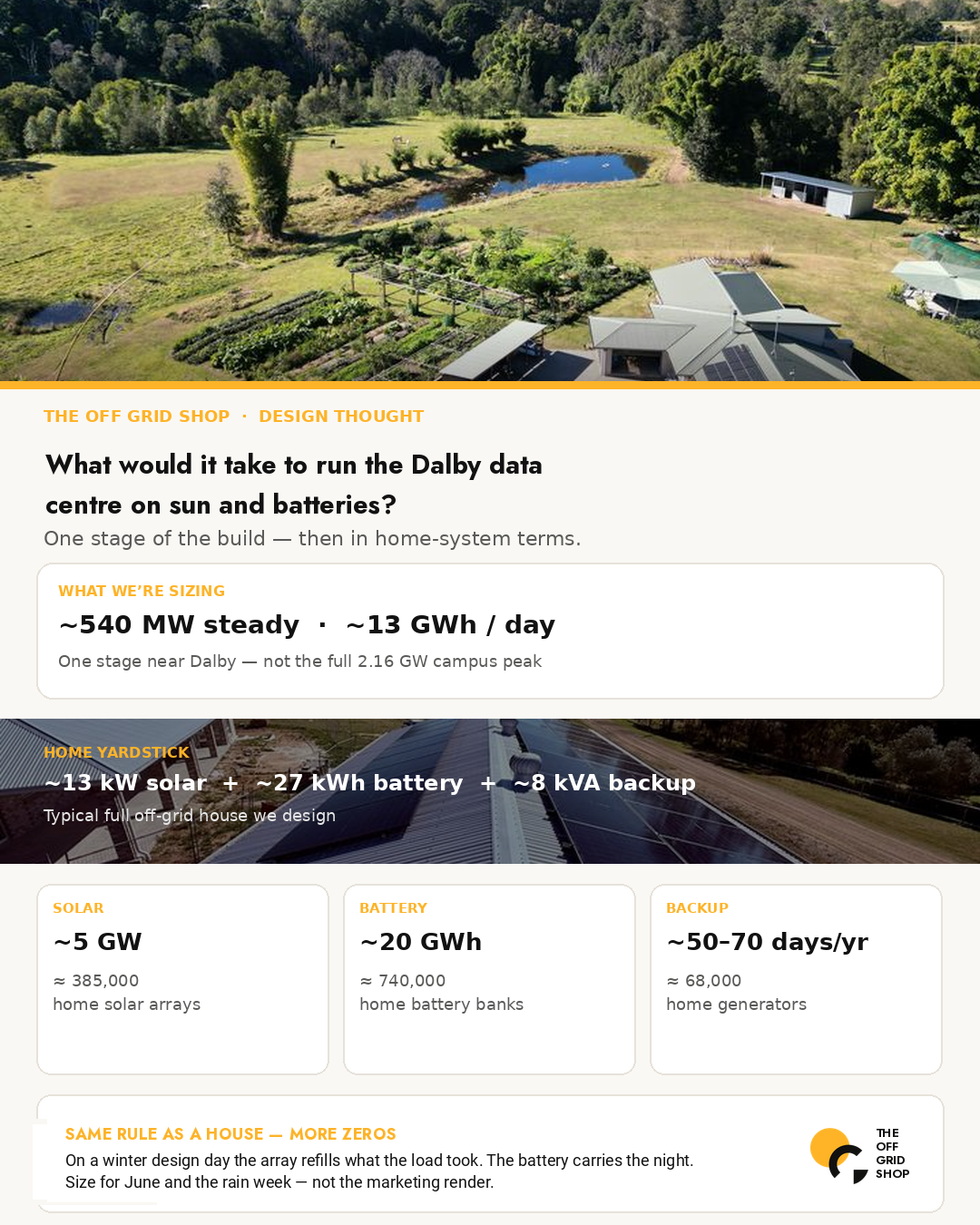
What we’re sizing
Public reports put the campus at four halls of about 360 megawatts of computer load each. Full-build peak is cited near 2.16 gigawatts. ABC put full-build daily use around 47 gigawatt-hours — roughly a quarter of Queensland’s average day.
For stage one we take about 540 megawatts running steady — call it 13 gigawatt-hours a day. That’s a working assumption. We don’t have their real day-to-day load shape, or how much extra the building burns for cooling. Anyone who quotes those as hard fact is guessing.
About 540 megawatts steady
About 13 gigawatt-hours a day.
2.16 gigawatts
About 47 gigawatt-hours a day.
Load and cooling
Real load shape and cooling overhead.
The mid-winter day near Dalby
BOM Dalby Airport (station 041522) is the climate anchor. Mean daily sun bottoms out in June around 12.2 MJ per square metre — about 3.4 kilowatt-hours per square metre on the flat. Annual average is about 5.4 kilowatt-hours per square metre per day. Winter here isn’t Tasmania. It’s still winter.
For a fixed-tilt field, after winter tilt and real system losses, you’re near about 3.2 kilowatt-hours AC per kilowatt of panels on a mean June day. On a proper grey day, treat that as maybe a third to half — enough to slow the drain, not enough to refill a flat battery while the load keeps drawing.
Same rule as a homestead, just with more zeros: on the winter design day, the array puts back what the load took, and the battery carries the night and the low-sun hours without drama.
Rain weeks beat averages
Dalby’s normals sit around about 85 cloudy days and about 53 rain days (1 mm or more) a year. What kills a stand-alone system is clumps: two or three poor days after you’ve already spent the pack overnight — especially May through August when the daily budget is thin.
You either:
Oversize solar
A mediocre day still pays the bill.
Buy more battery hours
More nights you can ride through.
Name backup days
Grid, gas, or diesel for the days you won’t.
Our house view is option three done honestly: aim for about 300 days where sun and batteries carry you, and plan for around 65 days where something else has to show up. At Dalby’s climate that’s plausible for a well-sized plant. It isn’t free, and it isn’t 365.
Hardware for about 540 megawatts running steady
About 4 to 6 gigawatts
Preferred sketch about 5 gigawatts — roughly enough to refill the daily 13 gigawatt-hours on a mean June day, with a bit of headroom.
About 13 to 26 gigawatt-hours
Preferred sketch about 20 gigawatt-hours — roughly a day and a half at full load.
Thousands of hectares
Far bigger than the campus fence. The panels live in the region, not inside a marketing render.
About 50 to 70 a year
Depends how hard you oversize and how unlucky the wet weeks are.
Scale the whole campus to 2.16 gigawatts and you’re in about 16 to 20+ gigawatts of solar and tens of gigawatt-hours of batteries. That’s not a “system.” That’s a state-scale power build with a data centre attached.
In home terms
Using a solid off-grid house yardstick — about 13 kilowatts of solar + 27 kilowatt-hours of battery + 8 kVA backup:
About 385,000 home arrays
On the order of 385,000 home arrays.
About 740,000 home batteries
On the order of 740,000 home batteries.
About 68,000 home generators
On the order of 68,000 home generators.
Same design rule as a farm or a house: size for June and the rain week — not the glossy flyer.
What the published plan is actually doing
On-site batteries in the reporting are there to keep the load tidy for the grid — smooth and stable at the connection — not to hold a day and a half of computing through a Western Downs wet week. Gas nearby is the bridge. Renewables bought on contract are the later chapter.
That may be a rational grid-connected plan. It is not the same as standing on your own when the wire is sick.
If your standard is standing on your own, you size sun and storage for the worst useful day you accept — and you name the days you won’t.
What it would take
One stage of a Dalby-scale data centre, mostly on its own sun and batteries: multi-gigawatt solar, tens of gigawatt-hours of batteries, most of the array off-site, and still around two months of days a year for grid or generators unless you spend even harder. Full peak is about four times that headache.
That’s what it would take.
Figures from Reuters, ABC, Brisbane Times and Capital Brief reporting on the September 2026 announcement, plus BOM Dalby Airport 041522 normals. Load shape and cooling overhead are working assumptions, not company disclosures.
Same rule at mine scale: Bellevue Gold ran four days with the engines off. More notes live on Learn.
Sized for June and the rain week
We design solar and battery plants for homes, farms, and commercial loads that care what happens in June and after three grey days. Start a custom design with The Off Grid Shop — or call or text 0483 927 257.